2009-10-04

Can I do this?

I'm a compulsive Tumblr who is utterly beyond rehabilitation. Something of substance coming soon.


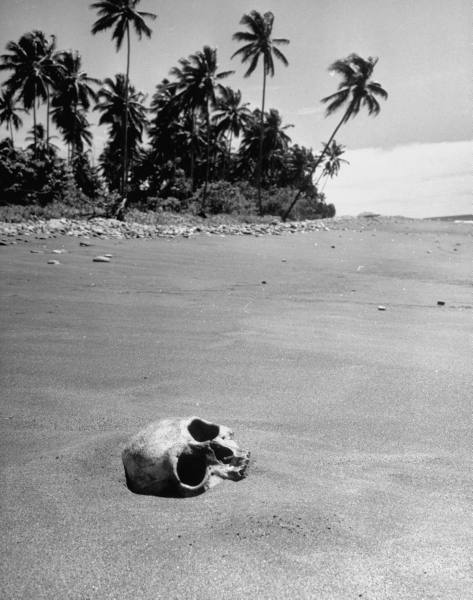
A Skull Lying Half Covered by Sand on the Beach. Guadal Canal, Solomon Islands, June 1951. Photograph by Howard Sochurek.

reflections on the first session

apologies in advance for the relatively disjointed nature of what I've written here- it reflects a thought in the process of development, and not a finished idea. i'd really appreciate any input because i'm very much not quite clear about how I think about these things...

i've been thinking about the theme claire brought up about repetition. the postminimalist artist eva hesse said 'endless repetition can be considered erotic,' in this way i think referring to eroticism as 'play,'with a set of variables that are changed and new. this also follows claire's points about how disaster allows us to reconceptualize our situations and make the new- for example the city planner recreating lisbon, or contemporary reconstructions (lets remember that actually while they were around NYers hated the twin towers, famously an ugly blot on the skyline- and though the subsequent quest for a 9-11 memorial has been basically fruitless, it has for better or worse symbolized a concept of rethinking the city, a sort of regeneration, as when forest fires create an area of emptiness that are actually crucial for the long term health of forests). Or as harry lime says in the third man, ''in Italy for 30 years under the Borgias they had warfare, terror, murder, and bloodshed, but they produced Michelangelo, Leonardo da Vinci, and the Renaissance. In Switzerland they had brotherly love - they had 500 years of democracy and peace, and what did that produce? The cuckoo clock.'' basically this simplistic idea is at the core of many more specific and complicated works- i'm thinking of 'radical reconstruction,' by lebbeus woods, which gives specific situations (sarajevo) and how destruction allowed for subsequent modification to the city. (http://www.amazon.co.uk/Radical-Reconstruction-Lebbeus-Woods/dp/1568982860)

so if repetition is play, a constant alteration of a cultural continuum, then is the catastrophe itself repetitive?
Even though it seems bracing and unprecedented, we are used to our cities being destroyed- to the extent that most major metropoli have many imagined catastrophes (those imagined for los angeles, for example, written about in 'the ecology of fear' by mike davis; but paris has banlieue 13, new york has escape from new york (not to mention actually dozens of movies that imagine a destroyed new york, etc)
i got a sense from what claire was saying about how maybe, catastrophe can offer a relief from monotony, even if terrifying. it can offer us central narratives to build around perhaps?
well, thats a lot of details that seem disorderly. but I guess the real question is, is disaster a catalyst for modernism, and actually is modernism a catastrophe?
modernity has
-destroyed dialects, family links, traditional ways of life, religious practices, etc

I guess i'm trying mainly to work my mind around the idea of catastrophe as repetition- even though it seems that unprecedentedness and shock is built into the concept, it does seem that perhaps it is repetitious or serial in nature.

disaster of the ordinary

http://video.nytimes.com/video/2009/10/03/health/1247464978948/tainted-meat.html

Paul's mention of "poles of Infamy" and his "quiet" examples made me begin to muse about the scale and amplitude of catastrophe.

This article and video made think about the catastrophe of the everyday, the ordinary. While this class traces large scale disasters-known and reported, or as Marko pointed out- the unreported, large trees crashing in the woods. We are bombarded, usually via "the human interest story" with the always unfolding disaster of just getting out of bed. That cup of coffee is carcinogenic, that burger is blighted, the very dust in the corner of out rooms-quite unsettled, poisons us one-by-one.

2009-10-03

Identifying the Intricate (and Two Stories!)

I would rather like to air some of my wonderings regarding catastrophe:

In this post, I don't want to question that catastrophe has endless meanings. I don't want to question anything at all, in fact. This thought shouldn't subvert anything; it's exploratory. Having been bombarded by images and theories surrounding Hiroshima (whose name has become synonymous with an attack, interestingly), suicide, earthquake, et cetera, I feel the need to become a little more sensitised to the intricacies of catastrophe and this post is only about one intricacy. It's difficult to position it, as I see it, but it's something to do with infamy, impact, and experience. I will try to explain more specifically in two sections below (Poles of Infamy, and Silence and Near Silence). Please remember that these sections are just mechanisms in order to identify what I want to discuss. It's not very easy to contribute to something intricate without going through where I think the intricacy is in the first place. Due to the personal and non-academic nature of those sections, it might seem unnecessary to some but, please, humour me!

Poles of Infamy

I see that Catastrophe can be dramatic and examples of such catastrophes are manifold: when I think 'catastrophe', 'disaster', 'cataclysm', or any other terms a thesaurus would recommend, I link it with 'bombs!', 'earthquakes!', 'death!'. The word does imply 'big things are happening and it's bloody obvious!'. Earthquakes, nukes, volcanic eruptions, if reported and in some way felt, roughly form one pole (for me, at least). Marko gave a great example of the other pole, when he mentioned the earthquake where all the witnesses died and it took days for news to filter of the destruction, by which point no one cared to report the quake internationally. This shows that a massively destructive quake needn't be infamous. Both poles don't have an ultimate: that is there isn't a 'most' infamous or a 'least' infamous, rather the poles are incredibly fuzzy but I want to focus in on some of the less infamous fuzz; something between the overt and reported and the unknown and unreported: perhaps something not quite silent but something extremely quiet, yet its impact may be far-reaching; the gravitational pull of such a disaster could be felt and not even known about! We might not even know that something had happened, however 'big' it was; it would just silently direct the flow of our existence. And I'm sure things like that do happen and do direct the flow of our existence and colour our experience of it, and we haven't the foggiest idea about it.

Silence and Near Silence

Now, I think I've identified what the Americans would call a 'ball park' and would like to draw an analogy. I want to think about an oft-cited lesson of John Cage and countless of his disciples: that there was no such thing as absolute silence. Even when you reach total sonic isolation in an anechoic chamber, you still hear the high buzz of your nervous system and low pumping of the blood around your body. With that in mind, I once produced a CD meant to relax me during one of my episodes of insomnia. I played recordings of incidental noises and gradually, and almost imperceptibly, faded them out over 40 minutes or so. That way, there would come a point, towards the end of the track, where the incidental noises on the CD would be a similar volume to the incidental noises in the room. I found that the noises nearer to the end of the track gave me heightened awareness of the 'silence'. I was consciously aware of silence, and the gaps in between almost inconceivable sound, half-imagining what true silence might be. At any rate, it got me to sleep!

I want to look at two micro-narratives from the same source in a similar way in order to approach things that might have massive affects but not be infamous (though, obviously, they are known about or I couldn't cite them). While we can't know the unknown, I think that we can approach its limits and half imagine it.

The Micro-Narratives

A few years ago, I saw a book that I wouldn't usually buy. The topic of animal extinction is of only minimal interest to me but this book, 'A Gap in Nature' (2001) by Flannery and Schouten was so remarkable in its presentation that I simply had to buy it. It profiles quite a few recently extinct animals and I want to reproduce two of those profiles as micro narratives in this blog. If I can get my scanner to work, I'll follow with beautiful pictures of those creatures!

Now, I've always liked micro-narratives and how fragments of information can work together to almost map out the contours of a much larger, inexpressible phenomenon. I see these two micro-narratives as contributing to an enormous pool of unidentified fragments, never to be united.

At last! Finally! I offer the Catastrophe Committee profiles of two extinctions that I find remarkable!

~~~~~~~~~~~~~~~~~~~~~~~~~~~~

Name: Huppe (Fregilupus varius)
Last Record: between 1835 and 1840.
Distribution: Reunion Island, Mascarenes.
'Starlings are great colonisers, and many islands once had their own distinct species, evolved from ancestors that arrived in the remote past. None was so peculiar as the hippe of Reunion Island, whose most distinctive feature was described by one ornithologist as a 'crest of pale, decomposed feathers'. Like man island birds, the hippe appears to have been remarkably unafraid of humans, and could even be knocked down with sticks. One resident wrote:

"their song was a clear note [and they were] very tame and, being young, I killed dozens of them. When I returned to the island after ten years in Paris, I found no further trace of them. I used to keep them in a cage without any trouble. They eat bananas, potatoes, cabbage etc."

The story is almost a parable of human interaction with vanished species, in which a carefree youth kills thoughtlessly, only to repent in maturity the loss of such magnificent creatures. The final cause of the huppe's demise may have been the introduction of rats and, given the above, their decline to extinction may have been swift. Given their adaptability to life with humans, it was a great pity that a captive population was not established.' (pp31)

~~~~~~~~~~~~~~~~~~~~~~~~~~~~

Name: Stephens Island Wren (Xenicus Iyalli)
Last Record: 1894.
Distribution: Prehistorically, North and South Islands, New Zealand; Historically, Stephens Island, New Zealand.
'Very few species have been exterminated by a single individual of another species, but such seems to have been the fate of this wren. Its last redoubt was Stephens Island in Cook Strait, between North and South Islands, where it survived until the New Zeealand government built a lighthouse there in 1894. The lonely lighthouse-keeper, David Lyall, decided that he must have a cat, and other a year or so that solitary feline exterminated the entire species. It brought them, one by one, to the lighthouse-keeper's door and, thinking them strange birds, Lyall sent seventeen little bodies for identification to a museum.

This, however, is not the entire story of this curious little wren, the only known perching bird ever to lose the power of flight. Fossils reveal that before the arrival of the Pacific rat of kiore (Rattus exulans) in New Zealand around 1000 years ago Stephens Island wren was common throughout the archipelago. Predation by the rat eliminated it from over 99 per cent of its habitat before the arrival of Europeans. A single cat was then enough to push this precariously balanced species into oblivion.

Lyall was the only European ever to see the birds alive, and even he observed them just twice. He reported that they ran about like mice among the rocks of their island home. Twelve of Lyall's specimens are still hed in museum collections.' pp83

~~~~~~~~~~~~~~~~~~~~~~~~~~~~

It's fairly obvious that other issues, or fragments of issues, are touched upon and beg further exploration, such as folly of youth and its' contribution to unforeseen consequences in the first micro-narrative, for example. And how, if the lighthouse keeper in the second story opted for a dog (which you'd think would be an obvious choice for a lonely man in a lighthouse, wouldn't you?) instead of a cat, the most extreme catastrophe of extinction would have been avoided - or at least deferred until the rats took over. I find these small details fascinating!

There we go!

It's unlikely that you've heard those stories before but what could be more catastrophic than to become extinct?

And, come to think of that, what about our own extinction? Will it be as uneventful? Would it, too, merit a little entry in a esoteric book? It will come at some point, surely but is it a catastrophe if we can't think about it, can't write about it?

Also, you can see that each story has an interesting and intricate web of reasons surrounding the extinction. For me, this highlights how deeply imbedded catastrophes are within the fabric of existence (if such a phrase is at all useful!).

I know this was a little long for a blog post, but I imagine this might be the place for such discussion!
2009-10-02

The Third Catastrophe Committee is in session

Welcome to the Third Catastrophe Committee. I'll sign you up as editors of the blog as soon as I have all your email address from Karen. For now, just a summary of roles:

Session 2: Nick, Shain, Alex D, Helen. Mind-mapper: Kai
Session 3: Robert, Marc, Paul, Alex M. Mind-mapper: tbc
Session 4: Joey, Christopher, Anna, Barney. Mind-mapper: Ross
Session 5: Walter, Tina, Alice, Dagmara. Mind-mapper: tbc
Session 6: Daniel, Sami, Jacob, Burhanuddin. Mind-mapper: Thomas
Keeper of the Map: Clare Heath

Helen Stokes is the mind map and session broker. If anyone wants to change the session they're working on, Helen will broker any mutually agreed swaps.

Looking forward to your posts.

Marko

2009-05-11

Michael Taussig has been hiding at the back of the classroom

So Michael Taussig has started a class called "Preëmptive Apocalyptic Thought: The Angel of History Reconsidered in Light of Climate Change, the War on Terror, and Financial Meltdown” at Columbia University...
The report from The New Yorker is making me wonder if we've been infiltrated:
"For the final session, the theme was the cyclical interrelationship of trauma and the apocalypse, and Thurner, after screening the movie, tried to create a theoretical framework for discussion by drawing a series of diagrams, all arrows and blobs, on the blackboard. “So here,” he said, drawing a swooping arc, “we’re coming around to catastrophe. But if we’re preëmptively thinking about it, it’s making it happen faster, right?” He stepped back and looked at the diagrams, puzzled."

link to the story

2009-03-22

utopia/dystopia/apocalypse - a playlist

a playlist written by the disaster:

The Dead Only Quickly (w/Neil Hannon) -- The 6ths
The Gulag Orkestar -- Beirut
The Future, Wouldn't That Be Nice? -- The Books
Earth Died Screaming -- Tom Waits
Sferics -- Alvin Lucier
Strange Pursuits -- Devo
Avalanche -- Leonard Cohen
Dancing In the Dark -- Diamanda Galás
Forest Of Memories -- Dumb Type
6.5 -- supersilent
The Bombs That Keep Dropping Make It Hard To Sleep -- Yellow Swans
Tabla Bol (Catastrophe) -- Asa-Chang & Junray
Atrocity Exhibition -- Joy Division
A Fire In The Forest -- David Sylvian
Messages from the Unseen World -- Matmos
4 or 5 Trees -- Rachel's
a tabula rasa -- Arvo Pärt

2008-12-07

(after the) collision course


If you still have an appetite for destruction, the Royal Academy has a 'bleak and austere' season running from the 13th (saturday the, alas). Sudden White has projections and lightboxes behind a post-apocalyptic London cityscape, Dark Materials has Banks Violette's blasted Church ruins and Burroughs, through a selection of films, is cast as puppet master to the mutant artistic proceedings.

2008-11-13

research (fragments)


2008-11-12

Evidence

Now that I have properly edited out any sensitive content and classified statements, I can now reveal to you the long awaited sound files of Catastrophe 08. Each file contains both Marko and Tom's lecture/presentations. Seemingly at complete random, I have included various fragments of discussions and class presentations. Play it in the background while you are reading over your essay and channel the lost spirits of the Catastrophe...

The First Catastrophe:
one
two

The Second Catastrophe
one
two
three

The Third Catastrophe
one
two
three

The Fourth Catastrophe
one
two

The Final Catastrophe
one
two

2008-11-10

Preparing For Emergencies

Some listening material for those of you that can afford a small break from essay writing.

It's from my small library of public information recordings; a roasting chestnut of "common sense useful advice" for all types of emergencies. If you lived in London (and I'm assuming the rest of the UK) a few years back, you may remember getting a pamphlet through your door containing advice on what to do in the event of a wide variety of disasters. My favourite part is about 3'30" into the recording where the male voice says "Of course, there are always going to be particular occasions when you should not go into a building. For example: if there is a fire."

Common sense from The Cabinet Office.

Here's a 4 minute excerpt.

If that's got you worried that you don't know enough about these issues, and you need to listen to the entire program (approx. 23 minutes) then there's also a full length version there (33mb)

Have a look at the website for more information

"Ready" The US version is friendlier looking but slightly more sinister for the fact, especially the 'Kids' section.

2008-11-06

Catastrophe 2008, in pictures


Hi everyone. Here are some pictures from a few of the Catastrophe sessions, especially the last one. I have completed the editing of the sound files, getting rid of loud background noises and excessive silences. The only think now is that I need a place to host the files. A friend of mine in Los Angeles has agreed to give me space on his server, I am just waiting for the ftp info. Check back soon for audio!